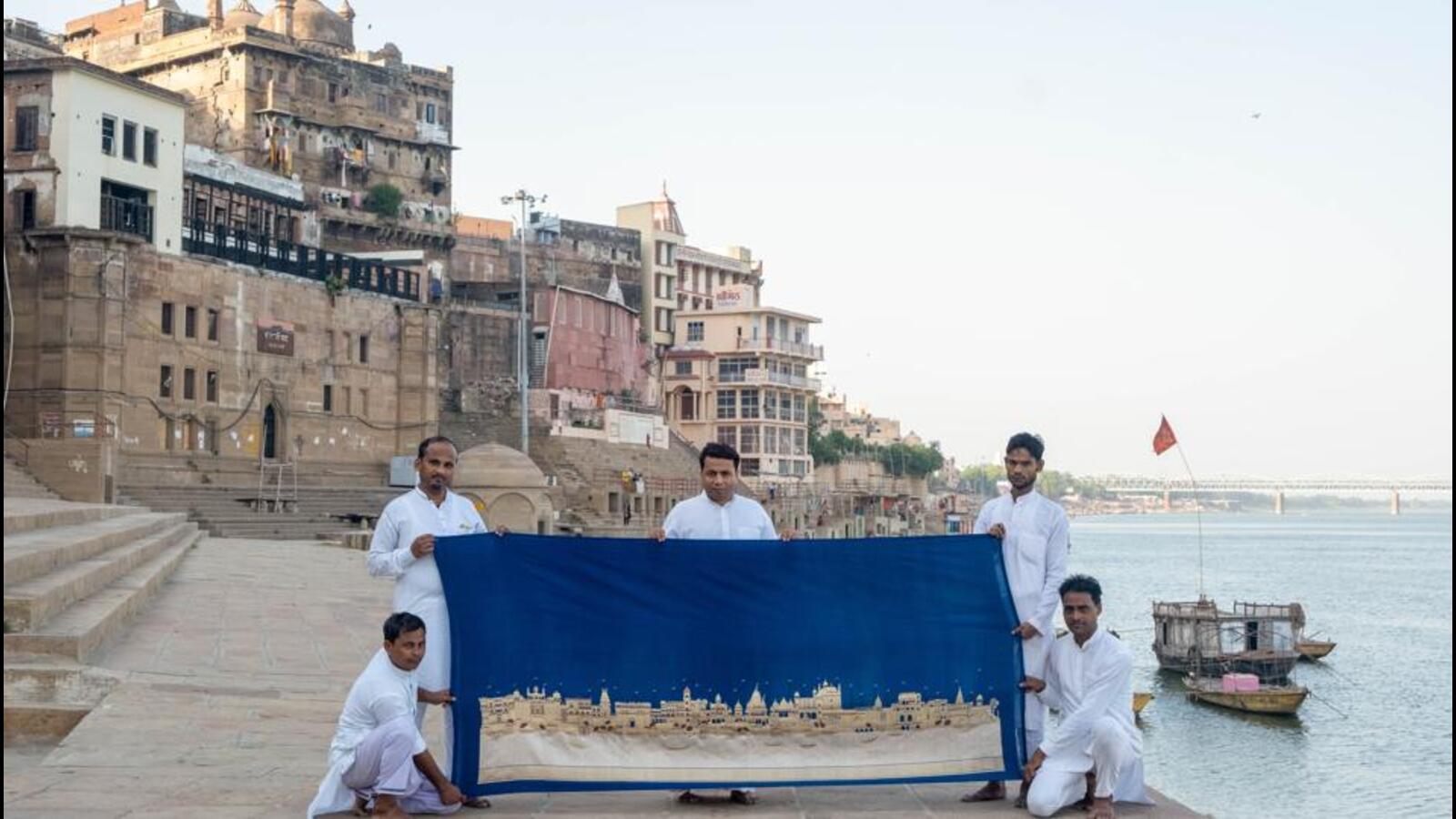
Last week, the first edition of the month-long Banaras Biennale commenced with a textile exhibition titled "Ek Dhaaga, Ek Duniya: Silk, Zari and the Light of Kashi" at the 106-year-old Bharat Kala Bhavan museum, housed within Banaras Hindu University since 1950. Curated by Pramod Kumar KG, the exhibition showcases more than 85 objects, including pieces from the museum's century-old textile collection, contemporary creations from local weavers, and designs by renowned fashion designers.
The exhibition offers a glimpse into the rich heritage of Banarasi weaves, featuring gold Baroque silks by master weaver Hasin Mohammed, heirloom Banarasis, rare meenakari textiles, recreations of temple friezes, and innovative creations like a Ladakh-meets-Banaras piece by Namza Couture. Notable inclusions are fabrics in metallic yarn and garments stitched almost entirely on the loom by Sanjay Garg for Raw Mango and designer Payal Khandwala, as well as an archival design from Bharat Shah of S&D Silks with Malayalam script woven into it.
At the other end of the market for Banarasis is a rangkat lehenga by Swati and Sunaina, woven by master weaver Saroj Chauhan. The profusion of Banarasi weaves ranges from the cheapest tier to its most inventive work, where the loom is reinvented to make what it never has before. Pramod asserted that "there is no such thing as Banarasi style; anything can be made in Banaras."
Another show held earlier this month, Aadyam Handwoven at Peshwa Haveli on Bala Ghat, highlighted the continuity and influence of architectural patterns on textiles. The exhibition traced Maratha influences alongside the legacy of trade and travel on the Silk Route, featuring brocades, tissues, mashrus, and a sari woven in brown cotton with zari. Hindustani classical singer Vidya Shah sang ghazals while wearing a sindoor-red Banarasi sari at the event.
The profusion of the Banarasi repertoire is not indicative of a healthy weaving ecosystem. While the handlooms behind the surge are fewer than suggested by visibility, premium brands like Tilfi Banaras, Shanti Banaras, and Ekaya, as well as retailers such as Swadesh, make efforts to name their weavers and techniques. The latest collaboration between Ashdeen Lilaowala and Ekaya founder Palak Shah features cheena-cheeni figures from the Parsi gara woven into Banarasi silk saris, which sold out on pre-order. Each limited-edition Swati & Sunaina sari comes boxed with a certificate, highlighting the unique craftsmanship and provenance of each piece.
The inaugural edition of the month-long Banaras Biennale, held last week, featured a textile exhibition titled "Ek Dhaaga, Ek Duniya: Silk, Zari and the Light of Kashi" at the 106-year-old Bharat Kala Bhavan museum located within Banaras Hindu University since 1950. Curated by Pramod Kumar KG, this exhibition showcases more than 85 objects that span the rich heritage and contemporary creations of Banarasi weaves.
The exhibition features pieces from the museum's century-old textile collection alongside contemporary creations from local weavers and designs by renowned fashion designers. Highlights include gold Baroque silks by master weaver Hasin Mohammed, heirloom Banarasis, rare meenakari textiles, recreations of temple friezes, and innovative collaborations like a Ladakh-meets-Banaras piece by Namza Couture. Notable inclusions are fabrics in metallic yarn and garments stitched almost entirely on the loom by Sanjay Garg for Raw Mango and designer Payal Khandwala, as well as an archival design from Bharat Shah of S&D Silks with Malayalam script woven into it.
At the other end of the market for Banarasis is a rangkat lehenga by Swati and Sunaina, woven by master weaver Saroj Chauhan. The profusion of Banarasi weaves ranges from the cheapest tier to its most inventive work, where the loom is reinvented to make what it never has before. Pramod asserts that "there is no such thing as a Banarasi style; anything can be made in Banaras."
Another show held earlier this month at Peshwa Haveli on Bala Ghat, curated by Aadyam Handwoven, highlights the continuity and influence of architectural patterns on textiles. The exhibition traces Maratha influences alongside the legacy of trade and travel on the Silk Route, featuring brocades, tissues, mashrus, and a sari woven in brown cotton with zari. Hindustani classical singer Vidya Shah sang ghazals while wearing a sindoor-red Banarasi sari at the event.
While the profusion of the Banarasi repertoire is not indicative of a healthy weaving ecosystem, premium brands like Tilfi Banaras, Shanti Banaras, and Ekaya, as well as retailers such as Swadesh, make efforts to name their weavers and techniques. The latest collaboration between Ashdeen Lilaowala and Ekaya founder Palak Shah features cheena-cheeni figures from the Parsi gara woven into Banarasi silk saris, which sold out on pre-order. Each limited-edition Swati & Sunaina sari comes boxed with a certificate, highlighting the unique craftsmanship and provenance of each piece.
The first edition of the month-long Banaras Biennale kicked off last week with a textile exhibition titled "Ek Dhaaga, Ek Duniya: Silk, Zari and the Light of Kashi" at the 106-year-old Bharat Kala Bhavan museum, housed within Banaras Hindu University since 1950. Curated by Pramod Kumar KG, this exhibition celebrates the rich heritage and contemporary creations of Banarasi weaves.
The show features more than 85 objects, including pieces from the museum's century-old textile collection, contemporary creations from local weavers, and designs by renowned fashion designers. Highlights include gold Baroque silks by master weaver Hasin Mohammed, heirloom Banarasis, rare meenakari textiles, recreations of temple friezes, and innovative collaborations like a Ladakh-meets-Banaras piece by Namza Couture. Notable inclusions are fabrics in metallic yarn and garments stitched almost entirely on the loom by Sanjay Garg for Raw Mango and designer Payal Khandwala, as well as an archival design from Bharat Shah of S&D Silks with Malayalam script woven into it.
At the other end of the market for Banarasis is a rangkat lehenga by Swati and Sunaina, woven by master weaver Saroj Chauhan. The profusion of Banarasi weaves ranges from the cheapest tier to its most inventive work, where the loom is reinvented to make what it never has before. Pramod asserts that "there is no such thing as a Banarasi style; anything can be made in Banaras."
Another show held earlier this month at Peshwa Haveli on Bala Ghat, curated by Aadyam Handwoven, highlights the continuity and influence of architectural patterns on textiles. The exhibition traces Maratha influences alongside the legacy of trade and travel on the Silk Route, featuring brocades, tissues, mashrus, and a sari woven in brown cotton with zari. Hindustani classical singer Vidya Shah sang ghazals while wearing a sindoor-red Banarasi sari at the event.
While the profusion of the Ban