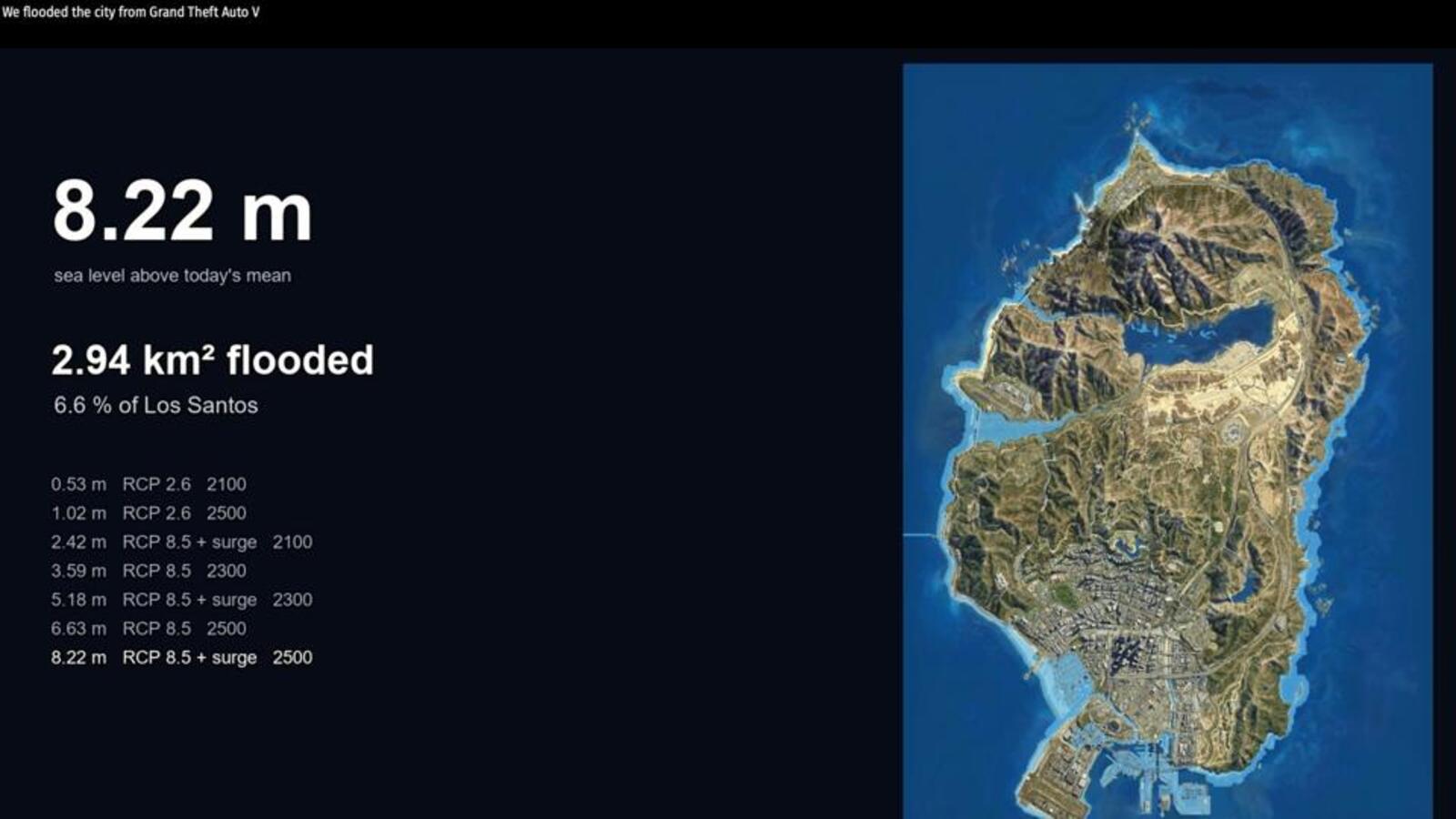
A team of researchers from the University of Potsdam and the Alfred Wegener Institute have utilized the virtual city of Los Santos, found in Grand Theft Auto V (GTA V), as a case study to model the effects of rising sea levels. This simulation coincides with the launch of GTA VI. Los Santos was chosen due to its faithful replication of real-life Los Angeles, enabling direct comparisons between simulated flood outcomes and actual urban landscapes.
The scientists employed Representative Concentration Pathway (RCP) scenarios from the Intergovernmental Panel on Climate Change (IPCC) Fifth Assessment Report (AR5). Under the RCP 8.5 scenario with storm surges, combined sea levels are projected to reach 5.18 meters by 2300, with 5.1% of the mapped land area inundated. This places crucial infrastructure such as ports, wastewater facilities, and coastal energy stations at risk. On the other hand, under the RCP 2.6 mitigation scenario, only 2.2% of the land area would be inundated by 2300 with storm surge, with no major infrastructure affected.
The researchers used a fan-built 3D model of the GTA V map and calibrated the sea level from 31 shoreline points against Mount Chiliad in the game. They then simulated IPCC scenarios for the years 2100, 2300, and 2500—each topped with a 1.59-meter storm surge, the highest Los Angeles has ever recorded. The results showed that the same districts in reality are also at high risk of flooding, such as Vespucci (similar to Venice Beach) and the Port of South Los Santos (as vulnerable as the Port of LA).
While GTA V is primarily a game designed for storytelling and action, its realistic virtual cityscape offers potential benefits for scientific modeling. The simulation can help players understand the emotional impact of climate change on familiar urban landscapes, bridging a gap that conventional visualizations struggle to achieve. However, it's crucial to recognize the limitations of the static inundation model, particularly in replicating finer natural nuances such as coastal erosion and shifting weather patterns. Despite these caveats, the researchers believe this approach can serve as a template for geoscience communication using open-world video game environments.