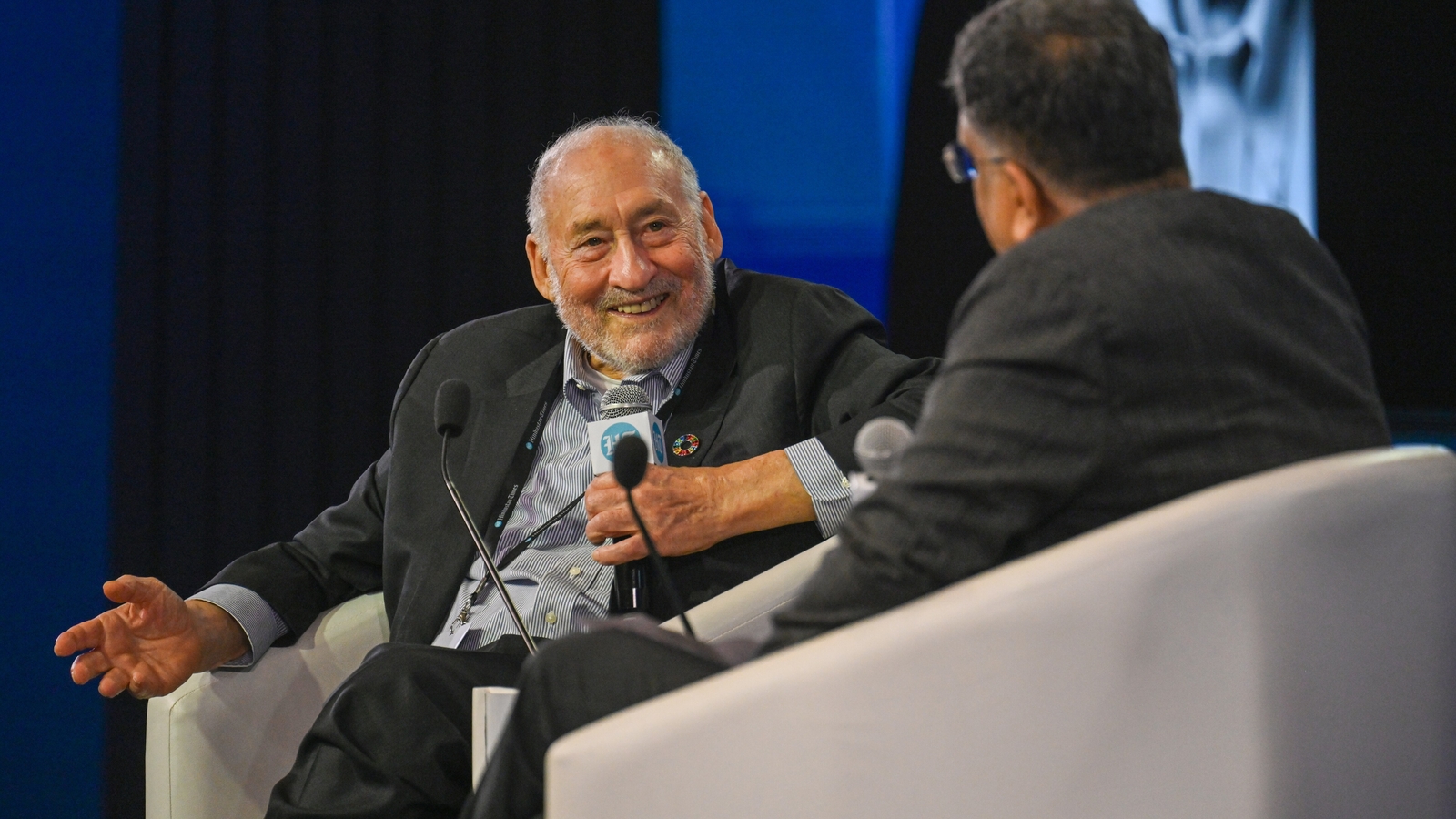
Nobel Prize-winning economist Dr Joseph E. Stiglitz has highlighted the United States' difficulty in accepting its diminished global economic standing, particularly in light of China surpassing it in terms of Purchasing Power Parity (PPP) around a decade ago. During a conversation at the 24th Hindustan Times Leadership Summit on November 14, Stiglitz expressed concern that President Donald Trump's policies towards universities and research could undermine the U.S.'s global position in the coming years. The economist, who served as the World Bank's chief economist from 1997 to 2000, emphasized that this reluctance to accept a changing global order is a significant issue for the world and warned of potential turmoil for the U.S.'s position over the next five years.
In his discussion with Artha Global Executive Director Dr Niranjan Rajadhyaksha in New Delhi, Stiglitz pointed out that the U.S.'s dominance in certain areas, notably universities, has been challenged under Trump's administration. He lamented that the administration's crackdown on universities and foreign students could harm the U.S.'s ability to attract top global talent, with half of these students being Indian. Stiglitz suggested that the world needs young, pragmatic leaders and collective action from middle powers to counteract bullying behavior from the U.S., particularly under President Trump's tenure.
Reflecting on the post-World War II era, Stiglitz noted that the U.S. was a dominant country in a unipolar system, competing with Russia but ultimately coming out on top. Today, however, we are moving towards a multipolar world, with China's GDP measured by PPP surpassing the U.S.'s a decade ago. Despite China's growth slowing since then, it still has an economy roughly twice the size of the U.S., according to the International Monetary Fund's October 2026 World Economic Outlook. Adjusted for Purchasing Power Parity, China's economy is projected to be around $44.6 trillion in 2026 compared to the U.S.'s $32.6 trillion, demonstrating the increasing economic gap between the two nations.