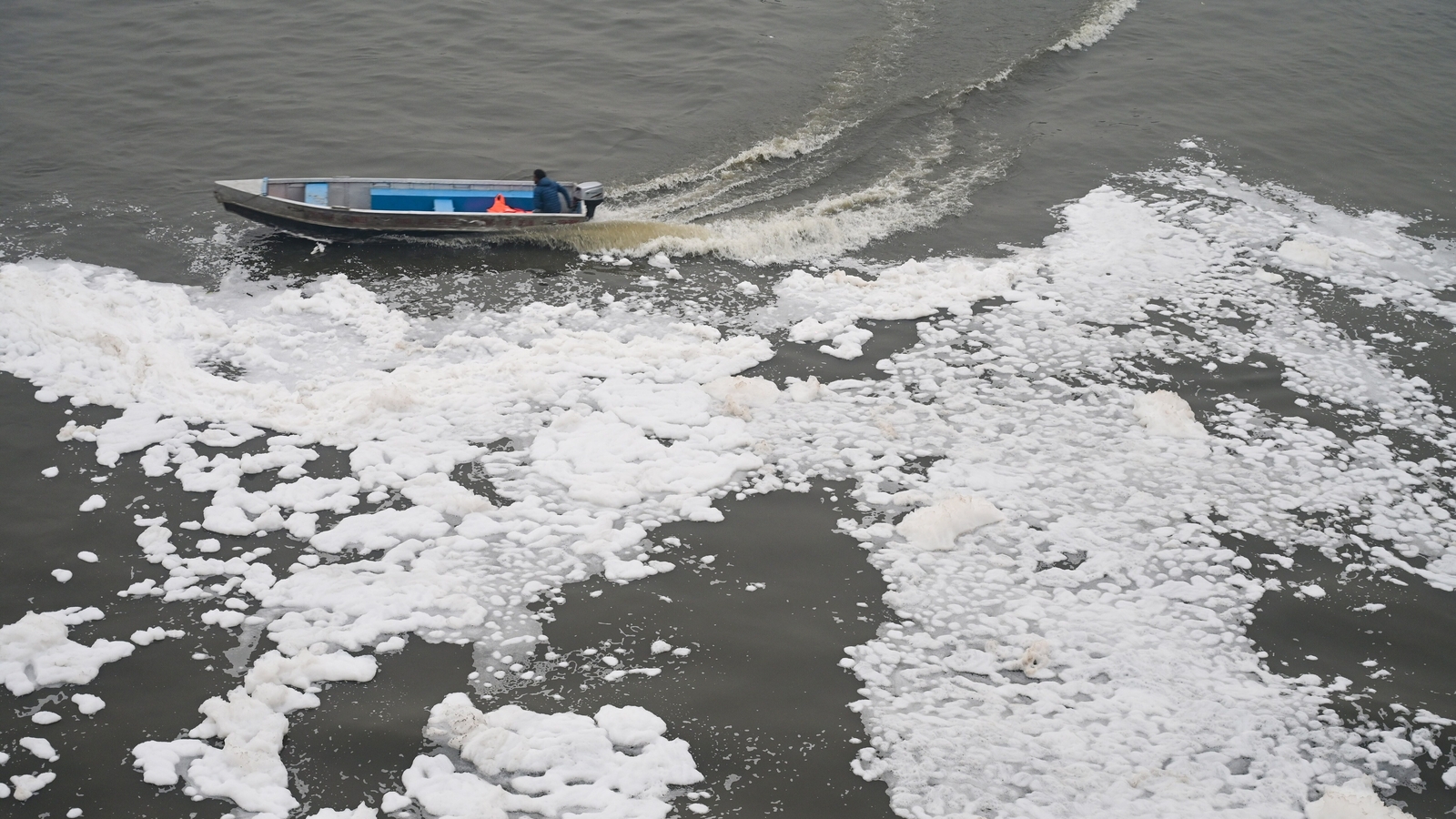
The Supreme Court of India has issued a directive to states, Union territories (UTs), and districts, imposing financial penalties if the quality of water in the Yamuna River deteriorates within their jurisdictions. This decision is aimed at holding responsible parties accountable for pollution in the river.
The court's ruling on Monday outlines a framework for monitoring water quality at entry and exit points along the Yamuna, with financial penalties for any deterioration. The Central Pollution Control Board (CPCB) has been instructed to suggest a formula for calculating these penalties. States and UTs will have the option to recover the imposed fines from polluters and negligent officials following an investigation.
The decision carries significant implications for Delhi, where a 22-km stretch of the Yamuna flows through but contributes significantly to the river's overall pollution load. The court emphasized that the condition of the Yamuna reflects the failure of civic administration across towns, cities, and villages along its banks.
The court highlighted the need for controlling industrial pollution and untreated sewage at their sources, acknowledging the difficulties in laying sewer networks in unauthorized colonies. It also addressed the issue of illegal and unauthorized colonies, JJ clusters along drains, and settlements on the riverbed, suggesting their removal after rehabilitating eligible occupants to prevent continuous pollution.
The court also focused on ecological protection, recommending that Zone 'O', designated as a green zone under Delhi's Master Plan 2047, should be protected and extended upstream and downstream from the Yamuna's source to its confluence with the Ganga. The court stressed the need for treating the Yamuna as one continuous ecosystem rather than state-wise stretches, invoking the principle of "common, but differentiated responsibilities."
The Yamuna flows through Uttarakhand, Himachal Pradesh, Haryana, Delhi, and Uttar Pradesh, making its conservation a shared responsibility. The CPCB has been directed to provide details of chemical composition and water quality parameters at points where the river and major drains entering it cross state, UT, and district boundaries. The court also ordered stricter monitoring of treatment infrastructure, including STPs, CETPs, and government-commissioned biogas plants.