During his tenure as India's sixth Prime Minister from 1984 to 1989, Rajiv Gandhi advocated for global nuclear disarmament and unveiled a plan at the United Nations General Assembly in 1988. However, this peaceful stance was contrasted by a secretive resumption of India's nuclear weapons program, an event that remains largely unexplored. Sonia Gandhi's autobiography, 'Belonging', sheds light on Rajiv Gandhi's commitment to non-alignment and disarmament but offers no insights into this discrepancy. In the context of escalating Cold War tensions in 1986, India found itself facing an existential threat from a nuclear-armed China, leading to the acceleration of its nuclear weapons program under Prime Minister Indira Gandhi in 1974. Yet, despite global pressure, India's nuclear ambitions were curtailed due to restrictions on nuclear cooperation and strengthened non-proliferation treaties. Rajiv Gandhi's visit to China in 1988 marked a thaw in relations, but behind the scenes, Pakistan's nuclear weapons program was advancing rapidly, leading to India's eventual reentry into the nuclear arms race.
In the aftermath of the humiliating loss in the 1962 border war with China, India found itself in a precarious position as China tested its first nuclear weapon in 1964 and a full-scale hydrogen bomb test in 1966. The threat of a nuclear-armed China necessitated a shift in India's foreign policy, leading to the development of a nuclear weapons capability under Prime Minister Indira Gandhi, culminating in the 'peaceful nuclear explosion' in 1974. However, further testing and weaponization were hindered by global pressure, resulting in a pause in India's nuclear program.
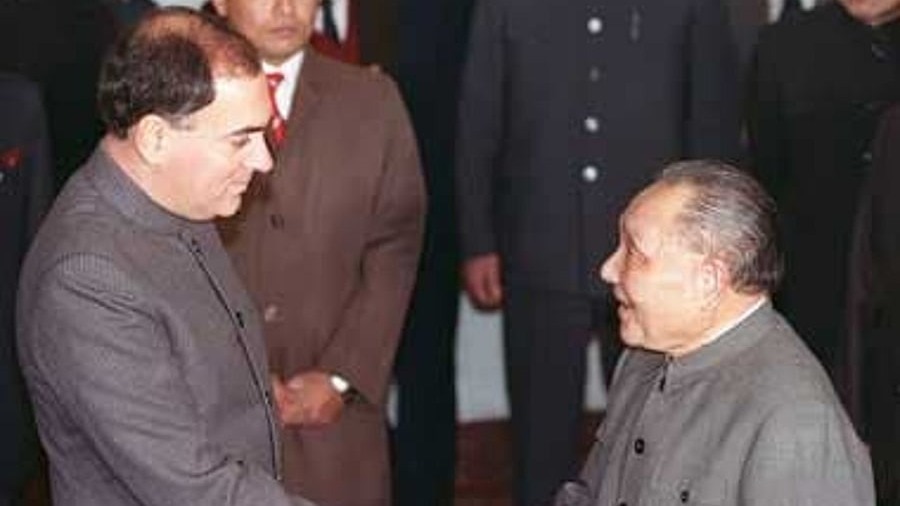
Rajiv Gandhi's visit to China in 1988 signified a significant step towards improving relations between the two countries. Sonia Gandhi's book highlights this meeting as a pivotal moment in Indo-China relations, but it also marked the beginning of India's response to Pakistan's advancing nuclear weapons program. The resumption of India's nuclear weapons program was driven by a need to counter Pakistan's rapidly progressing nuclear arsenal and ensure national security amidst increasing regional tensions.
While Rajiv Gandhi publicly advocated for nuclear disarmament, the resumption of India's nuclear weapons program revealed a more complex foreign policy approach. The tension between India's desire for peace and its need for self-defense underscores the challenges faced by nations in maintaining a balance between international cooperation and national security.