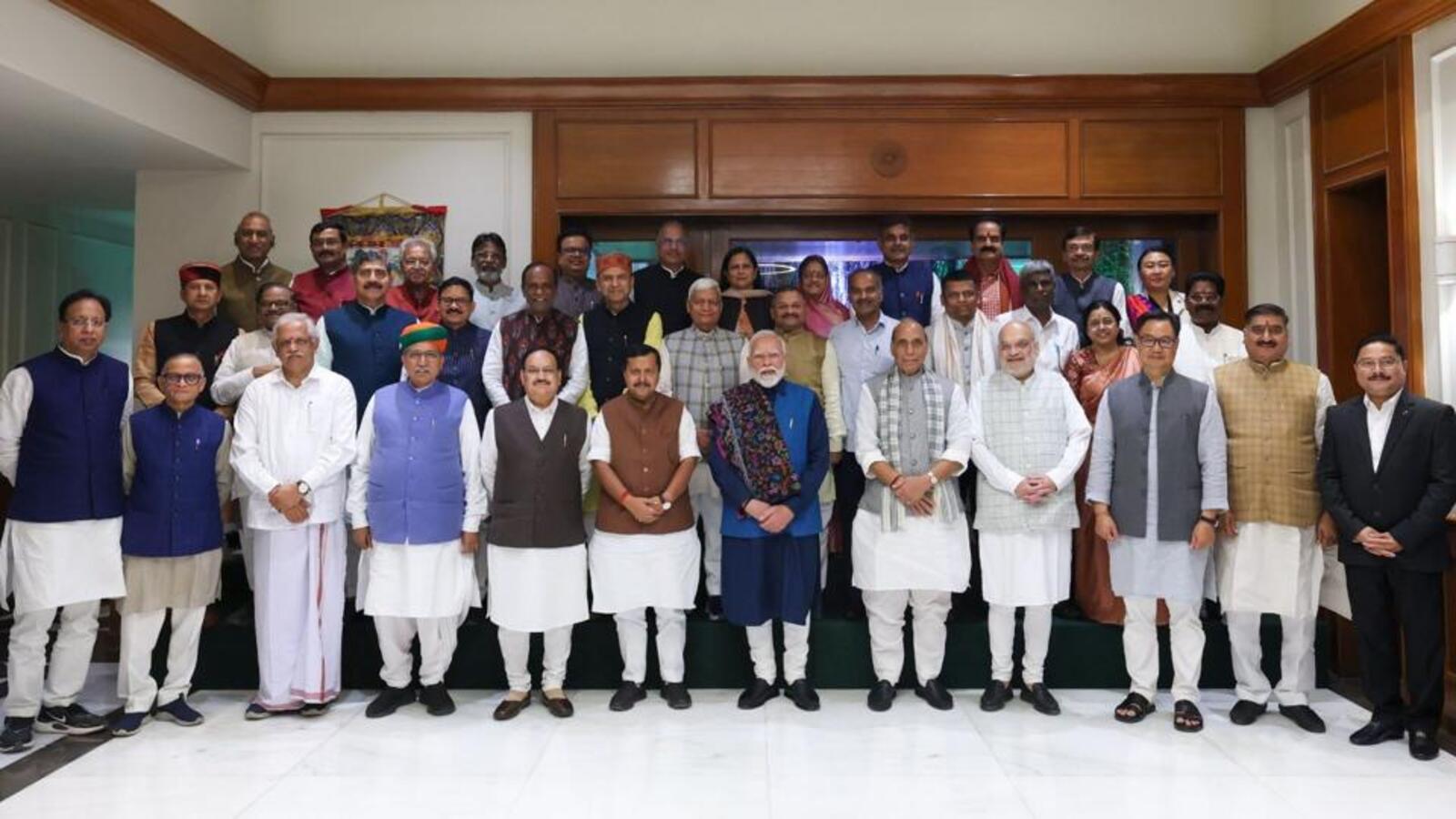
On Sunday, Prime Minister Narendra Modi convened a meeting with the members of the Bharatiya Janata Party's (BJP) parliamentary party executive committee in preparation for the upcoming special session of Parliament, set to commence on Monday. The gathering took place at 7, LKM, and involved key Union ministers such as Rajnath Singh, Amit Shah, JP Nadda, and BJP chief Nitin Gadkari, alongside party MPs from both the Lok Sabha and Rajya Sabha.
Following the meeting with the Prime Minister, several Union ministers, including Gajendra Shekhawat, Bhupinder Yadav, Kiren Rijiju, Manohar Lal Khattar, and Pralhad Joshi, among others, hosted lawmakers from different states for dinner to discuss and strategize for the forthcoming session. These meetings aimed to explain the voting process for the upcoming Constitutional amendment bill and the delimitation bill.
The Union government has expressed confidence in securing the necessary votes to pass both the Constitution Amendment Bill and the Delimitation Bill, despite renewed efforts by the Congress-led Opposition to persuade the Dravida Munnetra Kazhagam (DMK) to reconsider its support for these bills. The government anticipates that at least 371 Lok Sabha MPs will back the revised bills, which would enable the implementation of a 33% quota for women in legislatures by 2029.
In this special session, slated to run from Monday until December 3, the government intends to introduce three Bills: the Constitution (132nd Amendment) Bill, the Delimitation Bill, and the Union Territories Laws (Amendment) Bill. These legislative proposals aim to expand the Lok Sabha's membership by 50%, increase the number of seats from 543 to 816, freeze the distribution of inter-state seats until 2051, and establish a framework for a 33% quota for women starting from the 2029 general elections.
This is the government's second attempt at passing these bills, following the defeat of an earlier version, the Constitution (131st Amendment) Bill, in the Lok Sabha in April, with 298 votes in favor and 230 against, falling short of the two-thirds majority required.