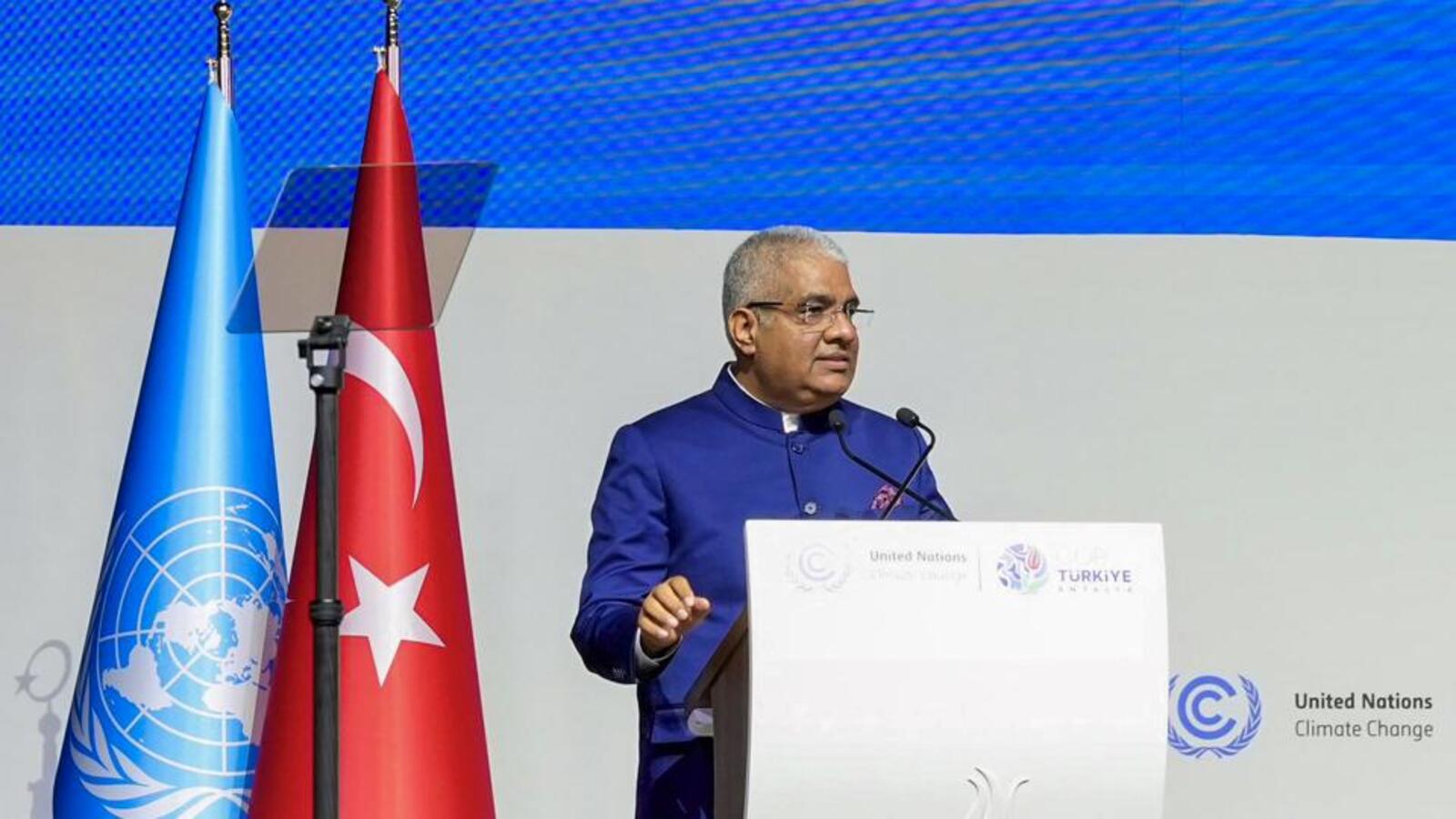
Union Environment Minister Bhupender Yadav delivered India's national statement at the 31st United Nations Climate Change Conference (COP31) in Antalya, Turkey, on Wednesday. Yadav emphasized that the Global South should not bear the brunt of historical emissions in the name of 'higher ambition'. He reiterated India's stance on climate action being rooted in equity, climate justice, and the principle of Common but Differentiated Responsibilities and Respective Capabilities (CBDR-RC). Yadav expressed concern that developing countries should not have to choose between climate action and their legitimate rights to development, decent living standards, health, and education. He underscored equitable access to the remaining carbon budget as non-negotiable.
The COP31 presidency initiated the second week of the conference in Antalya on Monday by presenting a draft decision document for dialogue, consensus, and action. The draft called for accelerated phasing out of fossil fuels, tripling finance for climate adaptation measures in developing countries, and electrification commitments. However, Yadav urged that COP decisions and their implementation must remain grounded in equity and CBDR-RC. He also advocated for the Mitigation Work Programme (MWP) to remain facilitative and non-prescriptive, the Global Stocktake (GST) to continue serving as an informative tool, and the Just Transition Mechanism (JTM) to be based on equity.
Yadav also voiced opposition to unilateral trade measures such as the European Union's Carbon Border Adjustment Mechanism (CBAM), arguing they could disadvantage developing economies and become barriers to trade. Finally, Yadav highlighted India's progress under Prime Minister Narendra Modi in aligning its Nationally Determined Contributions (NDCs) with the vision of achieving 'Viksit Bharat' by 2047 in a sustainable manner.
At the 31st United Nations Climate Change Conference (COP31) in Antalya, Turkey, Union Environment Minister Bhupender Yadav delivered India's national statement. He argued that the Global South should not bear the brunt of historical emissions in the name of 'higher ambition'. Emphasizing equity and climate justice, Yadav stated that developing countries must not have to choose between climate action and their legitimate rights to development, decent living standards, health, and education. He also stressed equitable access to the remaining carbon budget as non-negotiable.
The COP31 presidency launched the second week of the conference in Antalya on Monday by issuing a draft decision document for dialogue, consensus, and action. The draft aimed at accelerating fossil fuel phase-out, increasing finance for climate adaptation measures in developing countries, and promoting electrification commitments. Yadav urged that COP decisions and their implementation must remain grounded in equity and the principle of Common but Differentiated Responsibilities and Respective Capabilities (CBDR-RC).
Yadav also opposed unilateral trade measures such as the European Union's Carbon Border Adjustment Mechanism (CBAM), arguing they could disadvantage developing economies and become barriers to trade. Finally, Yadav highlighted India's progress under Prime Minister Narendra Modi in aligning its Nationally Determined Contributions (NDCs) with the vision of achieving 'Viksit Bharat' by 2047 in a sustainable manner.
Union Environment Minister Bhupender Yadav delivered India's national statement at the 31st United Nations Climate Change Conference (COP31) in Antalya, Turkey. He emphasized that the Global South should not bear the brunt of historical emissions in the name of 'higher ambition'. Yadav also reiterated India's stance on climate action being rooted in equity, climate justice, and the principle of Common but Differentiated Responsibilities and Respective Capabilities (CBDR-RC).
The COP31 presidency started the second week of the conference in Antalya by presenting a draft decision document for dialogue, consensus, and action. The draft aimed at speeding up the phasing out of fossil fuels, increasing finance for climate adaptation measures in developing countries, and promoting electrification commitments. Yadav urged that COP decisions and their implementation must remain grounded in equity and CBDR-RC.
Yadav also voiced opposition to unilateral trade measures such as the European Union's Carbon Border Adjustment Mechanism (CBAM), arguing they could disadvantage developing economies and become barriers to trade. Finally, Yadav highlighted India's progress under Prime Minister Narendra Modi in aligning its Nationally Determined Contributions (NDCs) with the vision of achieving 'Viksit Bharat' by 2047 in a sustainable manner.