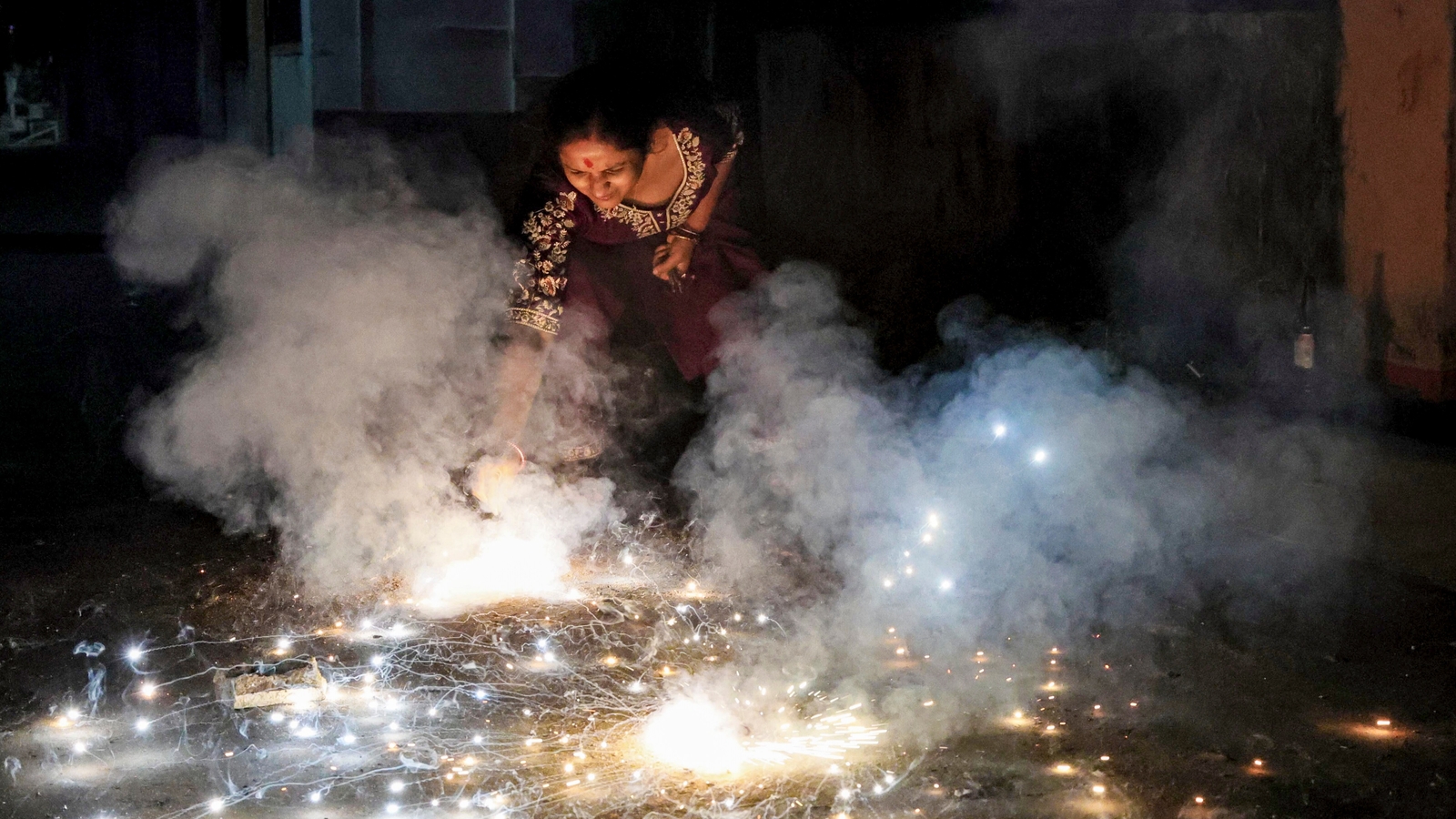
In the aftermath of the Diwali festivities in Delhi on November 8, a thick smog enveloped the city, with a study suggesting that firecrackers were primarily responsible for the deterioration in air quality post-midnight. The Indian Institute of Tropical Meteorology (IITM) in Pune assessed scientific data to determine that firecrackers accounted for 71.1% of PM2.5 pollution from 1am to 9am on November 9, following the conclusion of Diwali celebrations. PM2.5 refers to fine dust particles measuring 2.5 micrometres or less in diameter, and levels are typically measured in micrograms per cubic metre (µg/m³).
Additional contributors to pollution during this period included vehicle emissions, biofuel combustion, wood burning, and mineral dust; however, their impact was minimal compared to that of firecrackers. The IITM study indicated that the contribution of firecrackers to PM2.5 pollution on Diwali night surpassed levels seen on preceding days. Firecrackers were responsible for 43.4% of pollution on the eve of Diwali and only 5.6% from 1am to 9am on November 7, as well as over 29% air toxicity in the same period immediately following Diwali.
In a prior report, it was noted that despite Delhi becoming a 'gas chamber' on Diwali night, none of the city's monitoring stations recorded PM2.5 readings beyond 1,000. Last Diwali, 29 out of 39 stations registered at least one hour above 1,000, with the highest reading of 2,224 at NSIT Dwarka, according to data from the Central Pollution Control Board (CPCB) kept by OpenAQ, an open-data platform.
Subsequently, the CPCB clarified that the upper limit of these readings is capped at 1,000 µg/m³, in response to an earlier report suggesting that more than two-thirds of Delhi’s 59 air-quality monitoring stations went offline between 10pm and 6am on Diwali, when exposure to pollution was at its highest. Several areas in Delhi recorded an Air Quality Index (AQI) exceeding 400 on the morning after Diwali, with the average AQI at 376 in the 'very poor' category as of 7am. Some of the most polluted locations included Sonia Vihar, Burari Crossing, and Vivek Vihar.
The Supreme Court had granted permission for limited green cracker bursting on November 7 and 8, with a commitment to reinstate a complete ban starting November 9.